ALPS Cap Lock Plate System (Titanium) – Double-head L
Craniomaxillofacial reconstruction after trauma, tumour resection or secondary deformity rarely leaves a straight line to work along. The mandible is the hardest case: the plate has to restore the contour of the lower border, carry the segment while it consolidates, and turn up into the ramus at the angle. The SHUANGYANG ALPS Cap Lock Plate System (Titanium) – Double-head L is built around that transition. Both heads of the plate are L-shaped, every configuration is a 20-hole span from 116 mm to 254 mm, compression and locking holes sit in the same profile, and each plate is matched to its own cone guide.
Understanding the Fixation Challenge
A reconstruction plate has two jobs at once. It restores continuity and contour, and it carries functional load — bite force, muscle pull, the weight of a graft — before the bone has consolidated. Around the angle the problem compounds: the plate has to change direction from the body of the mandible to the ramus over a curve that no straight span follows. Bending a long plate by hand to make that turn concentrates stress at the bend, distorts the hole geometry, and makes screw seating less predictable. Where the cortex is thin and the host bone is compromised — after resection, radiotherapy or a previous failure — screw purchase is marginal to begin with, and a plate that loosens at the angle takes the rest of the reconstruction with it. What decides the result is the interface between plate and screw, and between plate and bone.
Design Built Around Stability and Adaptability
Each element of the Double-head L answers one of those problems, and nothing on the plate is there for appearance.
- An L-shaped head at both ends. The plate turns at both extremities, so it can wrap the angle and continue onto the ramus instead of crossing the corner as a straight span. Less freehand bending at the turn means less residual stress in the plate and a hole pattern that stays true where the screws go.
- Compression and locking in one profile. Compression holes along the plate allow the osteotomy to be closed with controlled compression; Cap Lock holes lock the construct once the position is set. Closing the gap and holding it are done with one plate, in one exposure — no second implant and no second step.
- Cap Lock angular stability. Screws lock into the plate, so plate and screws behave as a single fixed-angle unit. In thin cortical bone at the angle this protects whatever purchase is available and resists toggle and back-out under functional load.
- A matched cone guide for every size. Every plate pairs with its own cone guide — 2.0, 2.4 or 3.5 — so drilling and screw seating follow the same protocol across the range. The technique becomes repeatable, which shortens the learning curve and evens out results between cases.
- Contourable titanium, two working sizes. From the 116 mm, 2 mm-thick plate of the 2.0 series to the 254 mm, 4.1 mm plate of the 3.5 series, the profile can be contoured intra-operatively to the anatomical surface. Titanium keeps the construct light, limits stress shielding and stays compatible with follow-up imaging.
Product Gallery
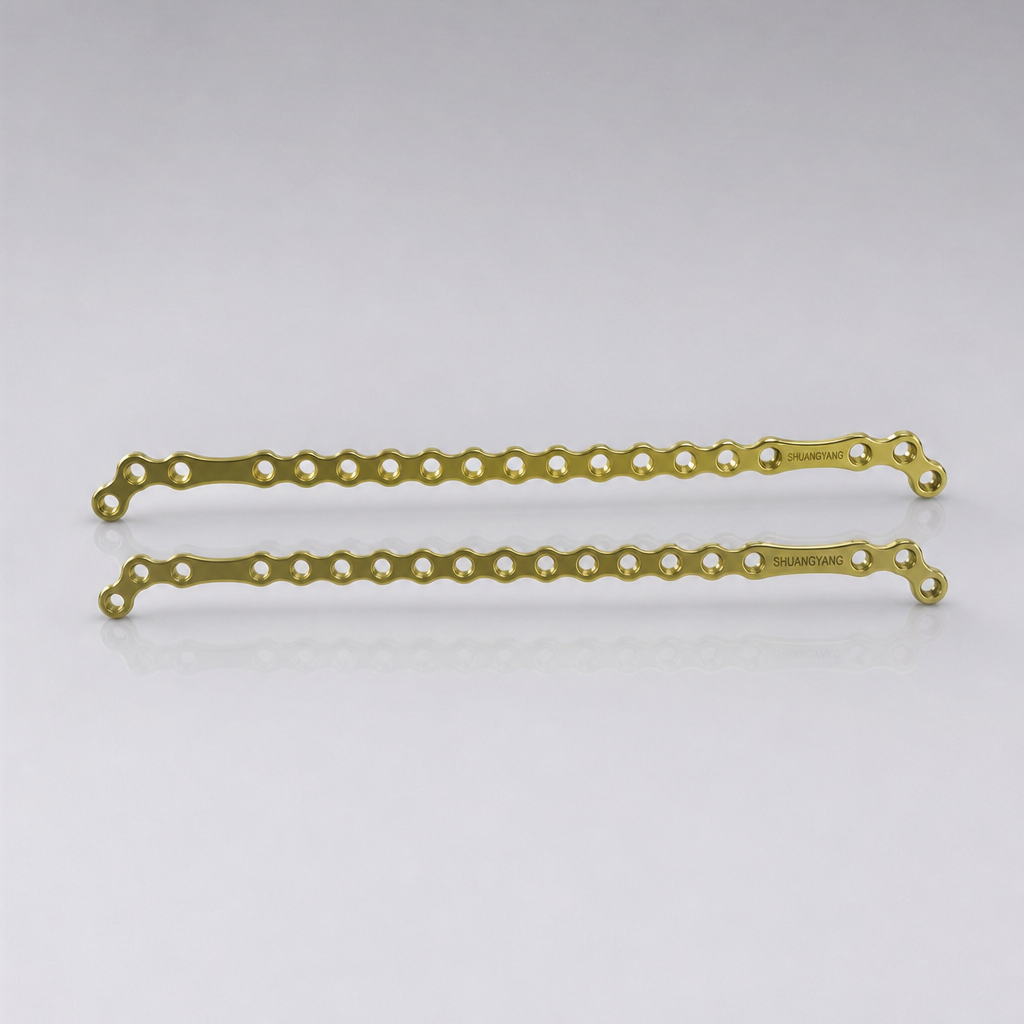
Product Advantages
Every advantage below traces back to a number in the specification table, so what the page claims is what the tray contains.
- Two series, six lengths, one geometry. 2.0 and 3.5 plates run from 116 mm to 254 mm on the same 20-hole layout and the same L-shaped heads, so symphysis, body, angle and ramus reconstruction can be covered from one family — fewer SKUs to stock and a faster choice in the operating room.
- One plate to close the gap and hold it. Compression holes and Cap Lock holes share the same span. The osteotomy is compressed and then locked without adding instrumentation or converting to another plate mid-case.
- Locking stability where the bone is thinnest. The angle is where cortex is thinnest and muscle pull is strongest. A fixed-angle Cap Lock construct protects screw purchase there and keeps the plate from toggling loose as the patient resumes function.
- Matched instrumentation instead of improvisation. Three cone guides cover the range and each plate ships with the guide it was designed for, so drilling depth and screw seating are consistent whether the case is a short body defect or a long angle-to-ramus reconstruction.
Technical Specifications
The full specification matrix from the official SHUANGYANG product sheet. All six configurations are 20-hole plates; they differ in thickness, width and length, and in the cone guide they are matched to. Browse related implants under Orthopedic Implants or the product catalog.
Table 1 — ALPS Cap Lock Plate System (Titanium), Double-head L
| No. | Products Name | Product Code | Specification | T/W/L (mm) | Matched Parts |
|---|---|---|---|---|---|
| 1 | 2.0 Double-head L Reconstruction Compression Locking Plate | 30217012051 | 20 holes | 116×5×2 | 2.0 cone guide |
| 2 | 2.0 Double-head L Reconstruction Compression Locking Plate | 30217012651 | 20 holes | 138×6.5×2.2 | 2.0 cone guide |
| 3 | 3.5 Double-head L Reconstruction Compression Locking Plate | 30217012571 | 20 holes | 189×7.5×2.6 | 2.4 cone guide |
| 4 | 3.5 Double-head L Reconstruction Compression Locking Plate | 30217012581 | 20 holes | 210×9.8×5.3 | 2.4 cone guide |
| 5 | 3.5 Double-head L Reconstruction Compression Locking Plate | 30217013201 | 20 holes | 235.8×10×3.6 | 3.5 cone guide |
| 6 | 3.5 Double-head L Reconstruction Compression Locking Plate | 30217013211 | 20 holes | 254.3×11.5×4.1 | 3.5 cone guide |
All plates are supplied with their matched cone guide. Prices, dimensional drawings and custom lengths are available on request.
Applications & Conclusion
Applications. The Double-head L plate is indicated for reconstruction and internal fixation of the mandible and craniomaxillofacial bones after trauma, tumour resection and secondary bone defects — particularly segmental defects of the body, angle and ramus where the reconstruction has to cross the angle and continue onto the ramus. The 2.0 series suits smaller and thinner segments; the 3.5 series carries longer, load-bearing spans up to 254 mm.
Conclusion. In a procedure where fixation quality decides how soon a patient returns to function, the SHUANGYANG ALPS Cap Lock Plate System (Titanium) – Double-head L gives the surgeon an L-shaped geometry that follows the angle, a locked construct that survives thin bone, compression and locking in one plate, and a matched cone guide for every size. For the complete catalogue, dimensional drawings, pricing and OEM enquiries, contact us at info@jsshuangyang.com.
Contact
Email: info@jsshuangyang.com
WhatsApp: +86 182 6187 0933
Need Double-head L plate specs or a quote?
Tell us the series you need (2.0 or 3.5), target length and matched cone guide — we reply within one business day with SKUs, lead time and MOQ.
Request a Quote