Why Veterinary Surgeons Choose Rod-Lock TPLO Plates for Canine Cranial Cruciate Ligament Repair
The TPLO procedure remains the surgical standard for dogs suffering from cranial cruciate ligament insufficiency. Rod-lock TPLO plates add an integrated locking rod to the construct, tying the plate and screws into a single rigid unit that resists toggle and loosening during the early healing phase.
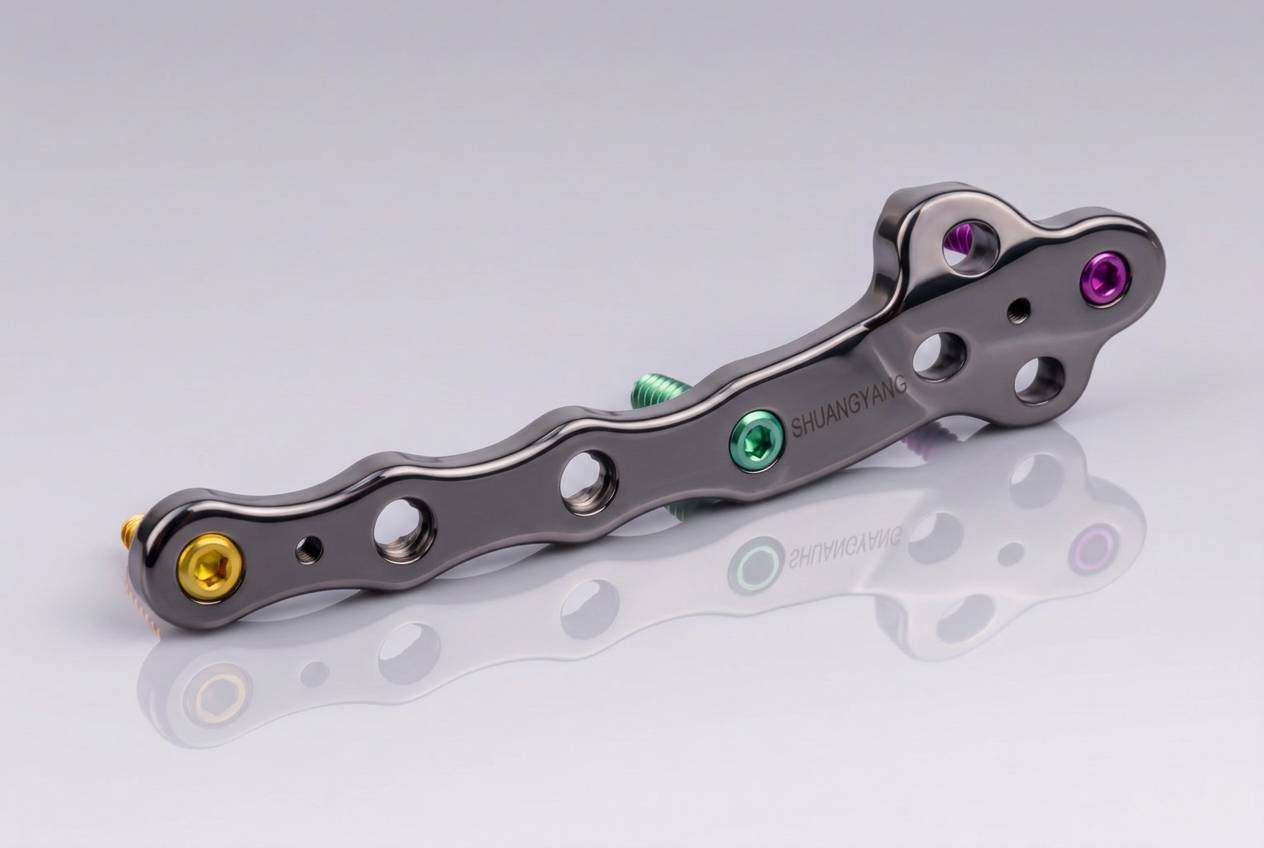
How the Rod-Lock Mechanism Reduces Plate Slippage and Construct Failure
A conventional TPLO plate relies on screws clamping the plate against bone; under repeated load the screw-bone interface can micro-move and lose alignment. The rod-lock design of this B-type system threads the locking screws onto an internal rod, distributing load across the whole construct instead of concentrating it on individual screws. Clinical feedback shows this reduces plate slippage and keeps the planned tibial plateau angle stable while the osteotomy consolidates, especially in active patients with high postoperative loading.
Improving Implant Adaptation for Variable Canine Tibial Anatomy
Canine tibial anatomy varies widely across breeds, so a single plate geometry cannot fit every patient. This system provides a graded range of sizes, each pre-contoured to the tibial surface of different dog weight classes.
Size-Graded Implant Range Covers Small Breeds to Large Working Dogs
The B-type rod-lock TPLO plate series runs from 5# to 10# and 10# Long, with left and right versions for every size. Plate thickness steps from 2.1 mm on the smallest size up to 4.1 mm on the largest, while width and length are matched to the implant size so that small-breed patients receive a low-profile plate and large working dogs get the load-bearing length they need. All plates are produced in titanium and are supplied with matched drill sleeves for reproducible screw placement.
| No. | Product Name | Product Code | Specification | T/W/L (mm) |
|---|---|---|---|---|
| 1 | TPLO Plate (Rod Lock) 5# | 030210010501 | 5# Left | 2.1*5*53.9 |
| 2 | TPLO Plate (Rod Lock) 5# | 030210010511 | 5# Right | 2.1*5*53.9 |
| 3 | TPLO Plate (Rod Lock) 6# | 030210020601 | 6# Left | 2.5*6*55.46 |
| 4 | TPLO Plate (Rod Lock) 6# | 030210020611 | 6# Right | 2.5*6*55.46 |
| 5 | TPLO Plate (Rod Lock) 8# | 030210030801 | 8# Left | 3.3*8*60 |
| 6 | TPLO Plate (Rod Lock) 8# | 030210030811 | 8# Right | 3.3*8*60 |
| 7 | TPLO Plate (Rod Lock) 9# | 030210040901 | 9# Left | 3.79*5*68 |
| 8 | TPLO Plate (Rod Lock) 9# | 030210040911 | 9# Right | 3.79*5*68 |
| 9 | TPLO Plate (Rod Lock) 10# | 030210051001 | 10# Left | 4.1*10*57.5 |
| 10 | TPLO Plate (Rod Lock) 10# | 030210051011 | 10# Right | 4.1*10*57.5 |
| 11 | TPLO Plate (Rod Lock) 10# Long | 030210047101 | 10# Long Left | 4.1*10*88 |
| 12 | TPLO Plate (Rod Lock) 10# Long | 030210047111 | 10# Long Right | 4.1*10*88 |
Left and Right Versions for Precise Intraoperative Selection
Each size is available as a dedicated left and right implant with its own part number, so the surgeon can select the correct anatomical plate at a glance and shorten intraoperative planning time.
Early Weight-Bearing Support Enabled by Rod-Lock TPLO Plates
Titanium construction with the rod-lock assembly distributes cyclic load evenly across the plate and screw array, rather than concentrating stress on any single screw. With this stable construct, many patients can begin controlled weight-bearing sooner after surgery. Earlier loading reduces joint stiffness, supports physiotherapy and helps dogs return to normal activity more quickly.
Preservation of Periosteal Blood Supply with Low-Profile, Cutout Design
The plate's low-profile, cutout design reduces contact area against cortical bone, which helps preserve periosteal blood supply around the osteotomy. Better local perfusion supports faster and more reliable bone healing while the rod-lock mechanism keeps the construct stable throughout consolidation.
Design Innovation: How Anatomy-Guided Engineering Meets Veterinary Surgical Needs
The system is engineered from the surgeon's workflow backwards, pairing each implant with matched instrumentation. Plate contours are pre-shaped to follow the tibial geometry of each size, keeping the implant low against the bone and reducing soft-tissue irritation. Contour-matched geometry limits plate-bone gaps, which improves stability and lowers the risk of postoperative discomfort.
Each plate size is paired with dedicated drill sleeves for threaded and tapered screws. These guides help the surgeon achieve a consistent drilling angle and depth, simplifying the implantation sequence and supporting reproducible TPLO outcomes. All plates are colour-coded titanium with locking screws, built for routine veterinary orthopaedic theatres.
Need rod-lock TPLO plate specs or a quote?
Send us your required sizes (5# to 10# Long, left or right) — we reply within one business day with specifications, lead time and MOQ.
Request a Quote