Small-Breed TPLO Is Moving Down the Weight Scale: What the 2026 Signals Actually Show

One implant launch, one product-line extension and one clinical case series all point at the same patient: the dog under 10 kg. The sourcing detail is more useful than the headline.
For much of the last two decades, the practical lower limit on TPLO was set less by the pathology than by the hardware. A plate designed around a 25 kg tibia does not simply scale down: hole spacing, plate length, screw diameter relative to cortical thickness and the diameter of the saw blade all have to fit a tibia that may be only 20 mm wide at the osteotomy site.
Professional-use notice
This article is written for veterinary surgeons, clinic purchasing staff and distributors. Procedure choice, implant selection and aftercare are case-specific and remain the responsibility of the attending veterinary surgeon. The text summarises published literature, manufacturer communications and product documentation available on the date shown; evidence levels are stated where relevant. Nothing here is a claim of safety, efficacy or regulatory clearance for any product, and nothing here replaces the instructions for use, applicable local regulatory requirements, formal training or clinical judgment. Product names and brands of other companies are cited only to identify the source of a published statement.
That constraint is now being addressed from several directions at once. Three signals — one implant launch, one product-line extension and one clinical case series — all point at the small and very small patient. Read together they describe where the catalogue gaps sit. Read separately, each carries a different weight of evidence, and the difference matters to whoever signs the purchase order.
Signal 1: a 1.5 mm-class TPLO plate aimed at toy breeds
A German veterinary implant manufacturer has published a case report describing TPLO in a 5 kg mixed-breed dog. The construct used in that case was a 2.0 mm locking TPLO plate; the company's 1.5 mm titanium plate line is presented in the same document as a newly available option for patients at the very bottom of the weight range.
Two details in that document deserve attention. First, the case itself does not demonstrate the 1.5 mm implant — it demonstrates the 2.0 mm one, and the document shows postoperative radiographs alongside an expected recovery, not a documented follow-up series. Second, the document is a supplier success story, not a peer-reviewed series: one patient, no control, no complication reporting.
What the document does supply is a rationale worth testing rather than repeating. Its author argues that smaller dogs typically present with higher tibial plateau angles, which increases strain on a lateral suture repair and raises the risk of suture breakage — the argument used to justify moving small patients from lateral suture stabilisation toward osteotomy-based correction. The rationale is clinically plausible and widely discussed; in this document it is not supported by cited comparative data.
Signal 2: a 30 mm wedge for the crossover breeds
A UK implant company has added a medium-size MMP wedge: 30 mm long, one advancement size of 7.5 mm, made from the same cancellous-structured material as its existing wedges. The stated motivation is specific and unusually candid. The company notes that dogs from 1.3 kg to 105 kg have been treated with either its 20 mm small-breed or 40 mm standard wedge, but that certain breeds — Springer Spaniels and Staffordshire-type dogs among them — sit at the crossover and are harder patients: a relatively short tibial tuberosity combined with a sharply narrowing tibial diaphysis.
The claim is anatomical fit, not clinical superiority, and the document is a launch announcement. The surgical procedure is unchanged; the addition is a 30 mm saw guide and a trial wedge supplied in an extension kit. For a distributor, that is the practical content: one advancement size that closes a dimensional gap, plus two extra instruments that have to be stocked alongside it or the wedge cannot be used.
Signal 3: a clinical series on 10 mm radial osteotomy
In November 2026 the American Journal of Veterinary Research published a case series on TPLO with a 10 mm radial blade in small-breed dogs, reporting lameness scores, radiographic union, gait analysis in a subset and owner-reported outcomes. We summarised the numbers and the limits separately. The relevant point here is the evidence type: a single-cohort clinical series without a comparator arm — the strongest of the three signals, and still not a comparative trial.
The paper also reports a practical observation worth carrying into any sizing conversation: maintaining at least one quarter of the tibial width at the osteotomy appeared to provide sufficient structural stability in the reported cohort. That is a bone-stock threshold, not a plate-size rule, and the authors explicitly note that smaller blade diameters such as 8 mm require further investigation before their safety and utility can be described as established.
Three signals, three different evidence weights
The table below is the part of the news cycle that tends to get flattened in a product launch email.
| 2026 signal | What was reported | Evidence type | What it does not establish |
|---|---|---|---|
| 1.5 mm-class titanium TPLO plate line | New plate line described as reaching toy-breed sizes; the single case shown used a 2.0 mm plate, not the 1.5 mm one | Manufacturer case report, n = 1 | That the smallest implant has been clinically evaluated, or any complication rate |
| 30 mm MMP wedge, 7.5 mm advancement | A medium size between the 20 mm small-breed and 40 mm standard wedges; procedure unchanged, with a new 30 mm saw guide and trial wedge | Manufacturer product launch announcement | Comparative outcomes against either existing wedge size |
| 10 mm radial osteotomy in small breeds | Case series reporting lameness scores, radiographic union, gait analysis in a subset and owner-reported outcomes | Single-cohort clinical series, no comparator arm | Superiority over other blade diameters, plate systems or techniques |
Where the catalogue gap actually sits
Strip out the branding and the three signals describe the same gap along three dimensions: length, screw diameter and instrument fit.
Length. A small-breed plate has to span the osteotomy and still place its distal screws inside bone. Shortening a plate usually means reducing hole count, which reduces the number of screws available to resist rotation. The 30 mm wedge and the tiny-plate line are both attempts to keep the span short without removing fixation points.
Screw diameter against cortical thickness. In a small tibia the cortex may be only a few millimetres. A screw that is appropriate for a 25 kg dog can leave very little purchase in that cortex, and a plate whose holes only accept one diameter leaves the surgeon no room to move down. This is the dimension where catalogue data — not marketing copy — decides the case.
Instrument fit. A new implant size almost always drags instruments with it: a different saw guide, a different trial wedge, a different drill sleeve or driver. The 30 mm MMP wedge is a textbook example — the wedge is useless without the 30 mm guide, and the guide is useless without tray space for it.
Six questions to ask before adding a small-breed line
These are procurement questions, not clinical recommendations. They are the ones that separate a usable SKU from a catalogue entry.
- What is the smallest tibial width the plate is documented for, and is that figure published or inferred from the design?
- Which screw diameters and lengths does each plate accept, and is a smaller-diameter option available within the same hole geometry?
- Is the plate a scaled-down version of a large-breed design, or re-proportioned for small anatomy? Ask for the dimensional drawing rather than the adjective.
- Which saw blade diameters and guides does the system specify, and are those instruments in the same tray or a separate kit?
- What documentation, labelling and language versions ship with the product, and what does the destination market require for this device class?
- What is the minimum order quantity per size, and can slow-moving sizes be held on consignment?
Inventory arithmetic, not just clinical enthusiasm
A small-breed line increases catalogue breadth faster than it increases revenue per SKU. Five plate sizes in three lengths plus two screw diameters is not one product; it is a tray configuration, a reorder point and a shelf-life record for each component. Clinics that treat a handful of sub-6 kg cruciate cases a month rarely justify a full ladder on their own shelf, while a distributor covering twenty clinics usually can.
The signals above are therefore most useful as a portfolio decision. If the sub-10 kg segment is growing in your market, the question is which two or three sizes you actually need to hold, and which can be supplied to order. The published dimensional data is what makes that calculation possible; the press release is not.
The evidence boundary, stated plainly
Two of the three signals are manufacturer communications. The case report covers one dog and does not follow that dog beyond the immediate postoperative period. The launch announcement reports a design change, not an outcome. The third signal is a clinical series without a comparator, which means it can describe what happened in one cohort but cannot attribute the result to the blade diameter, the plate or the surgeon's learning curve.
That does not make the signals unimportant — product ranges do shift, and the shift is real. It does mean that phrases such as “safe and effective”, “reliable” or “proven” belong to the sponsor that used them. They should not migrate into a distributor's own catalogue copy, a tender response or a training slide without the underlying data behind them.
What the Shuangyang range covers in this segment
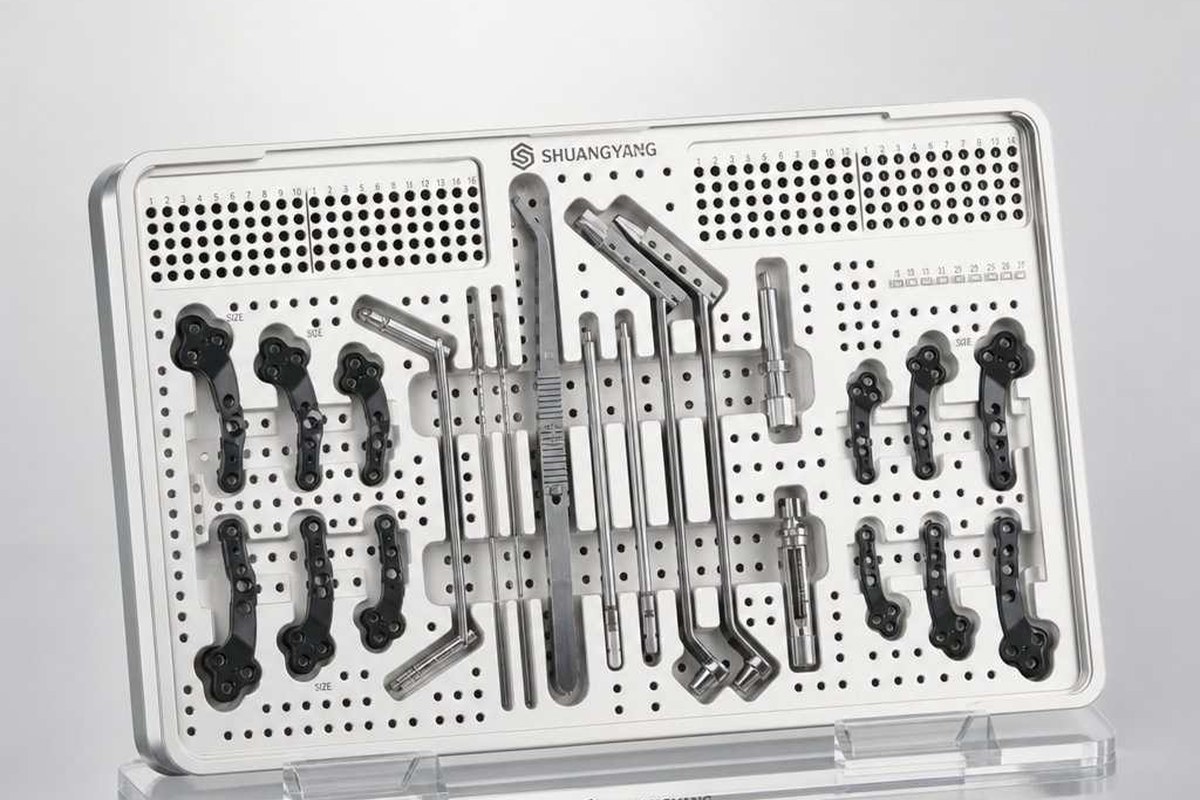
The Shuangyang TPLO range runs from a 2.0 mm plate through 2.4 mm, 2.7 mm and 3.5 mm to the TPLO III universal plate, with a 2.0 / 2.4 locking compression plate set supplied as a matched tray. Dimensional drawings, screw compatibility lists and matched instrument schedules are available on request, so a clinic or distributor can check a size against its own case mix before ordering.
For enquiries about small-size TPLO plates, matched instruments or tray configuration, contact the address below with the weight band and technique you are working to.
About Jiangsu Shuangyang Pet Medical
Jiangsu Shuangyang Pet Medical manufactures veterinary orthopedic implant systems and veterinary medical consumables for professional customers, including veterinary hospitals, clinics and distribution partners.
Contact
Email: info@jsshuangyang.com · WhatsApp: +86 182 6187 0933.
Sources
- Rita Leibinger Medical — “Tiny Plates, Big Impact: TPLO for Small Dogs” (case report by Dr. Jeff Mayo; accessed 26 November 2026) — https://leibinger.vet/wp-content/uploads/Success-Story-TPLO-2.0-Mixed-Breed-dog-5kg-by-Dr.-Jeff-Mayo-6.pdf
- Orthomed — new product launch: medium MMP wedge, 30 mm, 7.5 mm advancement (accessed 26 November 2026) — https://www.orthomed.co.uk/us/news/post/new_product_launch/
- American Journal of Veterinary Research, 2026 — 10 mm radial osteotomy in small-breed dogs (summarised on this site) — https://www.shuangyangorthopedic.com/blog/tplo-10mm-radial-osteotomy-small-breeds.html
Filling a small-breed gap in your implant tray?
Tell us the weight band, the osteotomy technique and the screw sizes your surgeons already use. We will send the dimensional drawings, matched instrument list, lead time and MOQ for the catalogue range.
Request a Quote