Veterinary Bone Plate Sizing Guide by Dog Weight
Choosing a bone plate for a canine fracture or osteotomy is rarely a single-number decision. Body weight is a practical starting filter for plate width, thickness and screw diameter, but breed, bone diameter, activity level, fracture pattern and soft-tissue coverage all matter. This guide summarizes commonly used starting ranges for veterinary orthopedic buyers and clinic teams stocking implants. It is not a surgical protocol.
Clinical disclaimer
All size ranges below are reference starting points for inventory planning and preoperative discussion. Final implant selection, contouring and screw configuration must be decided by the attending veterinarian based on radiographs, patient anatomy and intraoperative findings. Shuangyang does not replace clinical judgment.
Why Weight Is a Useful — but Incomplete — Proxy
Heavier patients transmit higher cyclic loads through the construct. As a rule of thumb, plate cross-section and screw purchase must rise with expected load. Toy and small breeds, however, often fail from soft-tissue irritation or oversized implants rather than from absolute strength. Cortical thickness, medullary diameter and the working length of the plate across the fracture gap usually decide whether a “book” size is too stiff or too flexible.
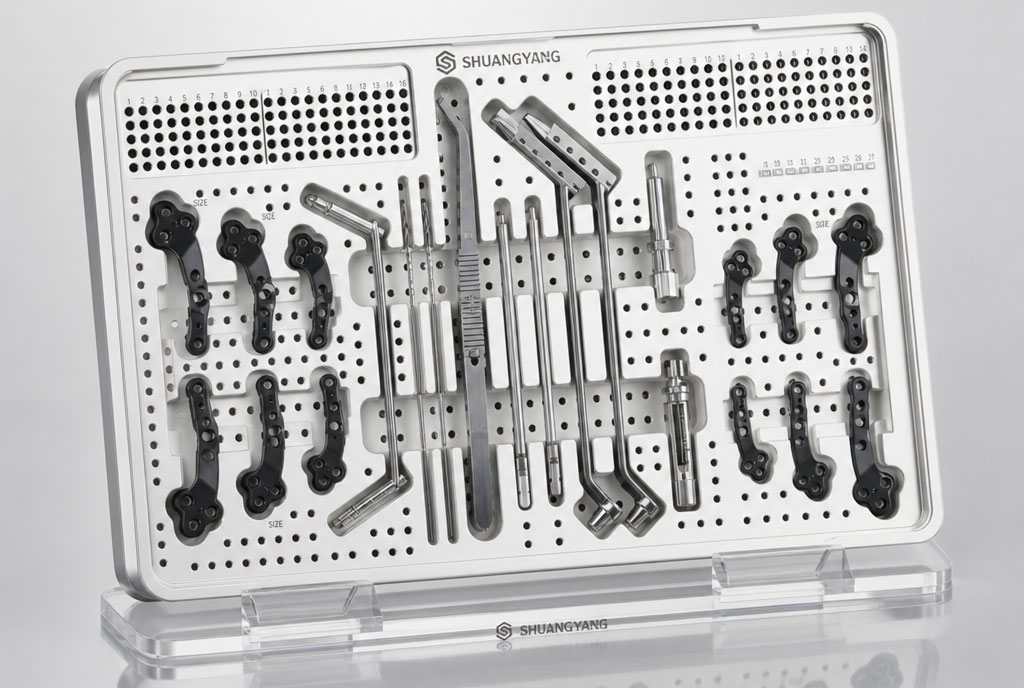
For clinic purchasing, weight bands still help you keep a coherent SKU ladder on the shelf — from low-profile cuttable plates for toy breeds up to 3.5 mm locking constructs for large working dogs — without over-ordering every hole configuration on day one.
Starting Size Matrix by Approximate Dog Weight
Use the table as an inventory and planning aid. Overlap between bands is intentional: many medium dogs can accept either a 2.4 or 2.7 system depending on bone size and fracture location.
| Approx. body weight | Typical plate / screw system | Plate thickness / profile (start) | Common applications |
|---|---|---|---|
| < 5 kg (toy) | 1.0–1.5 mm mini / cuttable; 1.5–2.0 screws | Low-profile cuttable or mini locking (~1.0–1.5 mm) | Metacarpal/metatarsal, distal radius, small long-bone bridges |
| 5–10 kg (small) | 2.0 locking / DCP-style; 2.0 screws | ~1.5–2.0 mm straight or T / cuttable | Radius/ulna, tibia, small-breed TPLO (e.g. 2.0 plate) |
| 10–20 kg (small–medium) | 2.4 locking / compression; 2.4 screws | ~2.0–2.5 mm | Long-bone fractures; small–medium TPLO (2.0/2.4 set) |
| 20–35 kg (medium) | 2.7 locking / LC-DCP; 2.7 screws | ~2.5–3.0 mm | Femur/tibia diaphysis; medium-breed TPLO (2.7) |
| 35–50+ kg (large / giant) | 3.5 locking / reconstruction; 3.5 screws | ~3.0–4.0+ mm as indicated | High-load long bones; large-breed TPLO (3.5 / III universal) |
Table 1 — Approximate starting ranges for canine bone plate and screw systems by body weight. Confirm against product IFU and surgeon preference cards.
Matching Plate Type to the Job, Not Only the Weight
- Straight locking / compression plates — diaphyseal bridges when you need a predictable working length and locking options for poor bone quality.
- Cuttable / X-type plates — short segments, pediatric-like bones, or cases where intraoperative trimming shortens inventory SKUs (e.g. 1.1 mm neutral cuttable, X-type cuttable).
- Reconstruction / specialty shapes (T, L, double-L, acetabular) — metaphyseal and periarticular work where contouring beats a straight bar.
- Procedure-specific systems — TPLO and TTA inventories should be stocked by size ladder, not by a single “medium dog” SKU. See our TPLO locking plate system overview and rod-lock TPLO guide.
Screw Diameter, Hole Fill and Soft-Tissue Profile
Screw diameter should generally stay proportional to bone diameter so that hole fill does not critically weaken the cortex. Clinics often standardize on colour-coded locking screws per system (2.0 / 2.4 / 2.7 / 3.5) and keep both locking and cortical options where the plate allows mixed fixation. Low-profile heads and limited plate–bone contact help in thin soft-tissue zones (distal radius, medial tibia), which is why mini and cuttable lines remain essential even when a heavier locking plate “fits” on radiographs.
Building a Practical Clinic Inventory Ladder
For a mixed small-animal caseload, many buyers start with:
- One mini/cuttable family for <10 kg patients and short fragments.
- A 2.0/2.4 locking ladder for small–medium long bones and small-breed TPLO (2.0/2.4 TPLO set, TPLO 2.0, TPLO 2.4).
- 2.7 and 3.5 TPLO / straight locking coverage for medium–large dogs (TPLO 2.7, TPLO 3.5, TPLO III universal).
- Matched drill sleeves, depth gauges and a documented sterilization / tray layout so sizes are not mixed between systems.
Browse the full orthopedic range under Orthopedic Implants, or start from the product catalog. Jiangsu Shuangyang Pet Medical lists 150+ SKUs across orthopedic and related lines, manufactured under ISO 9001 and ISO 13485 quality systems.
What to Send When You Request Sizing Help
To speed up a quote or size recommendation for stocking, include:
- Target species and typical weight bands you see in clinic
- Procedures you want to cover first (fracture, TPLO, arthrodesis, etc.)
- Preferred screw systems already on your trays
- Any left/right or size (#) matrices you already use for TPLO
For broader supplier due diligence beyond sizing, see how to evaluate a veterinary implant supplier.
Need a weight-banded plate & screw quote?
Tell us your clinic’s typical dog weight mix and priority procedures — we reply within one business day with suggested SKUs, lead time and MOQ.
Request a Quote