 EN
EN
 FR
FR
 ES
ES
 AR
AR

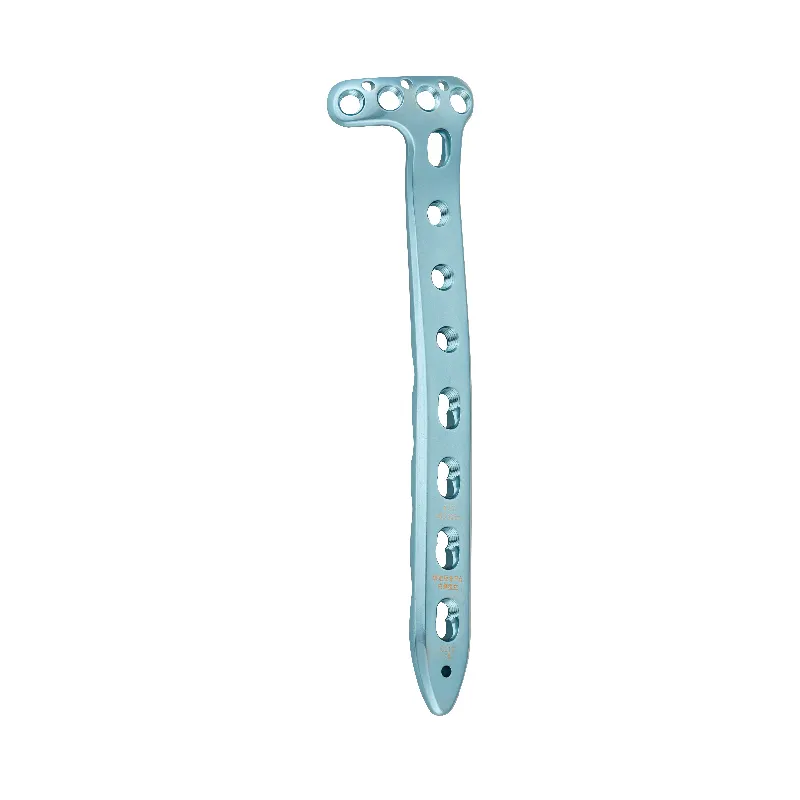
Why Design for Manufacturability Matters for Medial Proximal Tibia Plates
The application of Design for Manufacturability principles completely changes the game when developing orthopedic implants such as those used for medial proximal tibia fractures. When engineers focus on manufacturing considerations right from the start, they strike an important balance between creating devices that fit the complicated shape of the medial tibia bone and keeping production costs down for titanium components. Without proper DFM practices, problems like undercuts and complicated multi-axis machining can really slow things down, sometimes adding as much as 40% extra time to each production cycle and driving up what hospitals pay for each implant. This matters because many healthcare facilities are already dealing with budget constraints and increasing demands. Controlling tolerances in locking screw systems is especially crucial since even small deviations beyond plus or minus 0.1 mm can lead to serious issues during actual surgeries. The benefits extend further too - optimizing materials for Ti-6Al-4V forgings instead of using traditional bulk milling methods cuts waste by around 30%, which helps meet growing environmental concerns across the industry. Getting through FDA and ISO 13485 certification requirements adds another layer of complexity. These regulatory bodies require consistent manufacturing processes that simply cannot happen without thorough manufacturability assessments early in development. Bottom line? Incorporating DFM into the design process isn't just good practice anymore; it's absolutely essential if we want to produce quality implants that save lives while still being affordable enough for widespread adoption.
Anatomical Geometry and DFM-Driven Plate Design
When designers combine anatomical shapes with DFM principles, they change the way medial proximal tibia plates move from CAD drawings to actual parts that can be manufactured. Focusing on what's easy to make right from the start helps orthopedic engineers cut down on both machining time and wasted materials, all while keeping those important clinical specs intact. The real trick here is finding a middle ground between the body's complicated needs and what factories can actually produce. Sometimes simplifying certain geometric features makes sense for production purposes, even if it means making small compromises in how well the plate holds fractures together.
Mapping medial tibial curvature to simplify CNC toolpaths and reduce setup complexity
When we get accurate 3D maps of how curved the medial tibial plateau really is, designers can actually turn those complicated body shapes into much simpler paths for tools to follow during manufacturing. If we keep radius differences within about 15% of what's normal in anatomy, then computer controlled machines need about 30% fewer times changing tools and don't have to go through multiple setup steps either. Recent tests on bone mechanics show these simplified versions work just as well under pressure as the exact copies of real anatomy (with p values below 0.05). What matters most is finding parts of the curve that aren't so important medically. Making tiny changes there cuts down significantly on the complex 5 axis machining needed while still keeping all the screws placed correctly where they should be.
Minimizing undercuts and multi-axis features while preserving anatomical fit and locking screw angulation
Strategic elimination of undercuts and complex multi-axis features cuts milling time by up to 40% while maintaining essential locking screw trajectories between 5°–12°. Through parametric modeling, designers can replace hidden contours with stepped transitions that maintain plate-to-bone contact surface 90%. This DFM orthopedic implant engineering approach demonstrates how:
- Reduced tool access angles (from 180° to 90°) enable single-orientation machining
- Standardized pocket depths maintain required screw angulation tolerances
- Planar transitions replace complex compound curves in non-load-bearing zones
Validation testing confirms these optimizations preserve required compression forces (≥500N) while improving material utilization in titanium plate production by 22% compared to conventional designs.
Material, Process, and Tolerance Optimization for Titanium (Ti-6Al-4V) Production
Near-net-shape forging vs. precision milling: Balancing material yield, cycle time, and surface integrity
When it comes to choosing the right way to make Ti-6Al-4V plates, manufacturers need to look at what works best between near net shape forging and precision milling techniques. Forging actually saves a lot on materials since it only wastes around 15% compared to milling which can lose anywhere from 40 to 60%. Plus, the grain structure stays intact during forging, something really important when making parts for orthopedic implants where fatigue resistance matters most. On the flip side though, precision milling gets those dimensions spot on within about plus or minus 0.05 millimeters and creates much smoother surfaces with roughness values below 0.8 micrometers. This means less work after manufacturing is done. The bottom line? Companies should think carefully about whether they want to save money upfront with forging's 20 to 30 percent material savings or go for speed with milling that cuts production time by 15 to 25 percent for complicated shapes.
| Process | Material Yield | Surface Roughness (Ra) | Cycle Time |
|---|---|---|---|
| Near-net Forging | ≥85% | 1.2–1.8 μm | 8–12 hours |
| Precision Milling | 40–60% | 0.4–0.8 μm | 4–6 hours |
Tolerance stack-up control in multi-hole locking systems to ensure assembly repeatability and regulatory compliance
Tolerance stack-up management in locking screw holes dictates clinical success. Cumulative deviations exceeding ±0.1mm across 3+ holes risk screw cross-threading or reduced fixation strength. Implementing statistical process control (SPC) reduces positional variance by 50%, per ASTM F543 standards. Key strategies include:
- Fixture standardization: Dedicated jigs limit setup-induced errors to ≤0.03mm.
- In-process metrology: Real-time coordinate measuring machine (CMM) verification corrects tool drift.
- Thermal compensation: Accounting for titanium’s 9 μm/m·°C expansion prevents dimensional drift during machining.
This approach ensures 99.7% assembly repeatability under ISO 13485:2016, mitigating implant failure risks.
Finishing, Inspection, and Clinical Readiness as DFM Extensions
Surface finish (Ra < 0.8 μm) as a manufacturability-critical parameter for osseointegration and corrosion resistance
Achieving consistent surface roughness below 0.8 μm Ra (roughness average) is paramount in Design for Manufacturability (DFM) for medial proximal tibia plates. This specification directly impacts both biological integration and implant longevity:
- Osseointegration requires micro-scale surface texture to facilitate bone cell attachment, with studies showing 30% faster healing at Ra 0.5–0.8 μm versus smoother surfaces
- Corrosion resistance demands minimized surface defects to prevent pitting initiation in physiological environments
Getting electropolishing right is essential for getting rid of those machining marks but still keeping everything dimensionally accurate, especially near those locking screw holes where stress tends to build up. To validate whether it works, we need to take profilometer readings at about twelve different spots on each plate, which helps confirm things meet the ASTM F86 specs. Taking this design-for-manufacturability angle actually saves money down the road because nobody wants to redo work after the fact. Plus, there are two main goals here from a clinical standpoint. First, making sure bones fuse together quickly, and second, creating devices that can last fifteen years or more even when sitting in all sorts of corrosive body fluids without breaking down.
FAQ
What is Design for Manufacturability (DFM)?
DFM is a set of engineering principles that aim to make production easier and more cost-effective by considering manufacturing processes during the design phase.
Why is DFM essential in the production of medial proximal tibia plates?
DFM ensures that the design of the tibia plates optimizes machining processes, reduces material waste, and meets regulatory requirements, all while maintaining the necessary quality for surgical applications.
How does DFM impact the cost of manufacturing orthopedic implants?
By streamlining manufacturing processes and reducing material waste, DFM helps lower production costs, making these implants more affordable for healthcare facilities.
What are the benefits of near-net-shape forging compared to precision milling?
Near-net-shape forging enhances material yield and maintains grain structure, whereas precision milling offers precise dimensional accuracy and smoother surface finishes, each method catering to different production needs.
How does achieving a specific surface roughness (Ra) benefit the implant?
Maintaining a surface roughness below 0.8 μm Ra improves osseointegration and corrosion resistance, boosting the implant's biological compatibility and longevity.