 EN
EN
 FR
FR
 ES
ES
 AR
AR

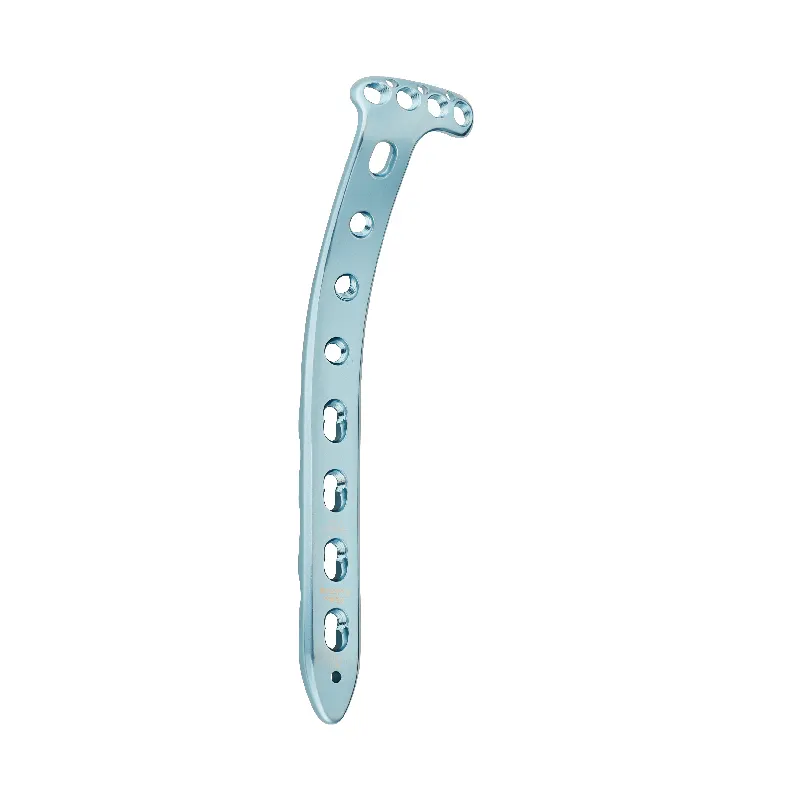
How Notch Sensitivity Drives Fatigue Failure in Distal Humerus Plates
Microcrack Initiation at Screw Holes Under Cyclic Physiological Loads
The screw holes found in distal humerus plates tend to concentrate stress naturally, making them prime locations where tiny cracks start forming when subjected to repeated physical stresses over time. Everyday actions like lifting objects, reaching overhead, or rotating the forearm create cyclic bending and twisting forces that build up stress right around these areas where the plate geometry changes abruptly. Research indicates that fairly normal forces around 500 Newtons happening at about 2 times per second (which is pretty much how most people use their arms day to day) can actually cause small cracks to appear after roughly ten thousand such movements in regular orthopedic plates. What happens next is pretty predictable too these little cracks generally develop at right angles relative to where tension is strongest, starting from the edges of those holes because the stress there gets amplified beyond what the metal can handle long term.
Three interrelated factors accelerate this process:
- Load magnitude: Higher forces reduce crack initiation cycles exponentially; doubling load may decrease cycles to failure by an order of magnitude.
- Bone quality: Osteoporotic bone characterized by reduced stiffness and heterogeneous density transfers uneven, elevated stresses to plate notches, intensifying local strain.
- Surface finish: Machining imperfections at screw holes introduce secondary stress risers, lowering the effective fatigue threshold by up to 20% in titanium alloys.
Once initiated, microcracks propagate incrementally through the plate's microstructure with each loading cycle, progressively degrading mechanical integrity until catastrophic failure occurs.
Stress Concentration Amplification (Kt) in Titanium Locking Plate Notches
Stress concentration factors, often called Kt values, basically tell us how different shapes and features in materials can make stress levels go way up in certain spots. For those distal humerus implants made from Ti-6Al-4V alloy, these Kt values usually fall somewhere between 2.3 and 3.8. What does that mean? Well, it means that at some key points in the implant, the actual stress experienced is actually over three times higher than what we'd normally expect. And this matters a lot because titanium has what engineers call "high notch sensitivity." When there are these little cuts or changes in shape, the metal just doesn't hold up as well under repeated stress. Tests show that when Ti-6Al-4V samples have these notches, their ability to withstand fatigue drops anywhere from 40 to 60 percent compared to samples that are completely smooth on the surface.
Under simulated forearm rotation (combined bending-torsion), Kt and associated fatigue strength reduction follow distinct patterns:
| Loading Condition | Kt Range | Fatigue Strength Reduction |
|---|---|---|
| Pure Bending | 2.3–2.8 | 45–52% |
| Combined Torsion | 3.1–3.8 | 58–63% |
The fatigue notch factor (Kf) basically measures how materials resist cracks that start at notches, which explains why working with titanium requires such careful attention to notch shapes. If designers don't take steps to reduce stress points through things like rounded corners or better placement of holes, then cracks will tend to spread from those screw holes all the way out to the edges of the plate. This kind of stress buildup eventually leads to component failure when subjected to real world loads that we see in clinical settings.
Titanium vs. Stainless Steel: Why Notch Sensitivity Demands Material-Specific Evaluation for Humerus Plates
Ti-6Al-4V's Higher Notch Sensitivity Under Bending and Torsion in Osteoporotic Bone Simulations
The titanium alloy Ti-6Al-4V shows much higher sensitivity to notches compared to stainless steel when used for distal humerus plates, especially in the tricky situation of working with osteoporotic bone. Studies using finite element analysis have found that because titanium has a lower elastic modulus around 110 GPa versus stainless steel's approximately 200 GPa, the strain at screw holes goes up between 25% to 40% when subjected to similar bending and twisting forces. The good news is that this property actually helps reduce stress shielding effects in normal bone tissue. But there's a downside in weaker bones where stiffness is already low. What makes titanium beneficial in some cases turns against it here - the very flexibility that protects surrounding bone structures ends up creating bigger problems at those notches, leading to faster development of tiny cracks that can eventually cause failures.
Tests on osteoporotic bone models show just how real this risk is. Titanium plates actually fail about 30% quicker than their stainless steel counterparts when subjected to similar twisting forces. What's interesting here goes beyond simple material properties. There's something else happening too related to how poorly the bones transfer loads to these implants. And let's face it, titanium has this weakness at stress points that makes all the difference clinically speaking. It's not just some minor detail from materials science anymore.
ASTM F3065-16 Testing as a Mandatory Benchmark for Notch-Driven Fatigue Thresholds
ASTM F3065-16 sets out a solid framework for assessing how trauma fixation plates handle fatigue caused by notches. According to this standard, manufacturers need to test different screw hole arrangements using cycles that combine both bending and twisting forces. These tests should mimic what happens naturally in the upper arm during regular movement, covering things like normal torque levels and range of motion. For a plate to pass inspection, it needs to withstand at least five million cycles without showing any cracks starting or spreading. This requirement matches what we typically see in terms of how long upper limb implants last functionally in real patients.
The test results show pretty clear differences between materials. Titanium components generally have about 15 to 20 percent less fatigue resistance compared to stainless steel when tested under the same conditions. This happens because titanium is much more sensitive to stress concentrations around notches. The ASTM F3065-16 standard actually prohibits using data from smooth specimens to predict real world performance. Instead it demands testing with notches that match what we see in actual clinical situations. Design changes become absolutely necessary rather than just nice to have improvements. Things like making webs thicker, adding rounded corners at stress points, or changing how screw holes are shaped aren't optional tweaks anymore. They're essential for patient safety. Companies that only look at basic strength numbers or data from un-notched samples might miss the exact type of failure that shows up most often in retrieved implants.
Clinical Impact: Linking Notch Sensitivity to Implant Failure in High-Risk Patients
Retrieval Evidence: Notch-Initiated Cracks in Failed Synthes LCP Distal Humerus Plates
Looking at retrieved Synthes LCP distal humerus plates that have failed, we find again and again that the screw holes are where these fatigue fractures start. When examining the broken surfaces, they show all the telltale signs of gradual fatigue failure - those distinctive beach mark patterns, striations, and crack arrest lines - everything pointing back to the notch areas. The numbers don't lie either; quantitative tests reveal Kt values above 3.0 right at these failure points, which confirms that localized stress concentration is what's causing problems, not just someone putting too much weight on the implant or making a mistake during surgery. What makes this even more concerning is how it matches what doctors see in practice. Around 12 to 20 percent of all distal humerus fracture repairs end up with fatigue-related implant failures. These cases tend to hit older adults and people with osteoporosis particularly hard because their bodies simply don't heal as well, and there's less room for error when it comes to implant performance in these populations.
Elderly Osteoporosis and 'Biological Plating': When Reduced Stiffness Exacerbates Notch Sensitivity Risks
The concept behind biological plating is to keep the blood flow going to the periosteum while cutting down on soft tissue damage these are pretty good ideas for better fracture healing. But things get tricky with older folks who have osteoporosis. When we put in those longer plates with fewer screws and they stick out more than usual, it actually creates bigger bending forces right around where the screws go into the bone. Titanium isn't helping much here either because it's not as stiff as other materials. Some computer models suggest bones affected by osteoporosis can take about 40 percent more strain at those weak spots compared to normal bones of similar age. What makes titanium so appealing in general biocompatibility, won't corrode, and matches bone's stiffness pretty well turns against us when there are issues with how the implant is shaped, if the surface isn't perfect, or if the way weight is applied isn't ideal.
Clinically, this manifests as early fatigue failure despite technically sound surgery and adequate bone contact. Recognizing that notch sensitivity is not a fixed material property but a system-level behavior shaped by bone quality, implant design, and activity profile is essential for tailoring fixation strategies to high-risk patients.
FAQ
- What causes microcracks in distal humerus plates? Microcracks form at screw holes due to concentrated stress from cyclic physiological loads encountered during everyday actions like lifting or rotating the forearm.
- Why is titanium more sensitive to notches compared to stainless steel? Titanium has a lower elastic modulus, resulting in higher strain at screw holes under bending and torsion forces, especially in osteoporotic bone situations.
- What does ASTM F3065-16 standard entail for humerus plate testing? It requires testing of trauma fixation plates under simulated conditions mimicking forearm movements to assess fatigue resistance, ensuring implants endure at least five million cycles without crack initiation.
- Why are older patients at higher risk for implant failure? Elderly osteoporosis reduces bone stiffness, exacerbating notch sensitivity risks and making titanium plates more prone to fatigue failure under stress concentration.