 EN
EN
 FR
FR
 ES
ES
 AR
AR

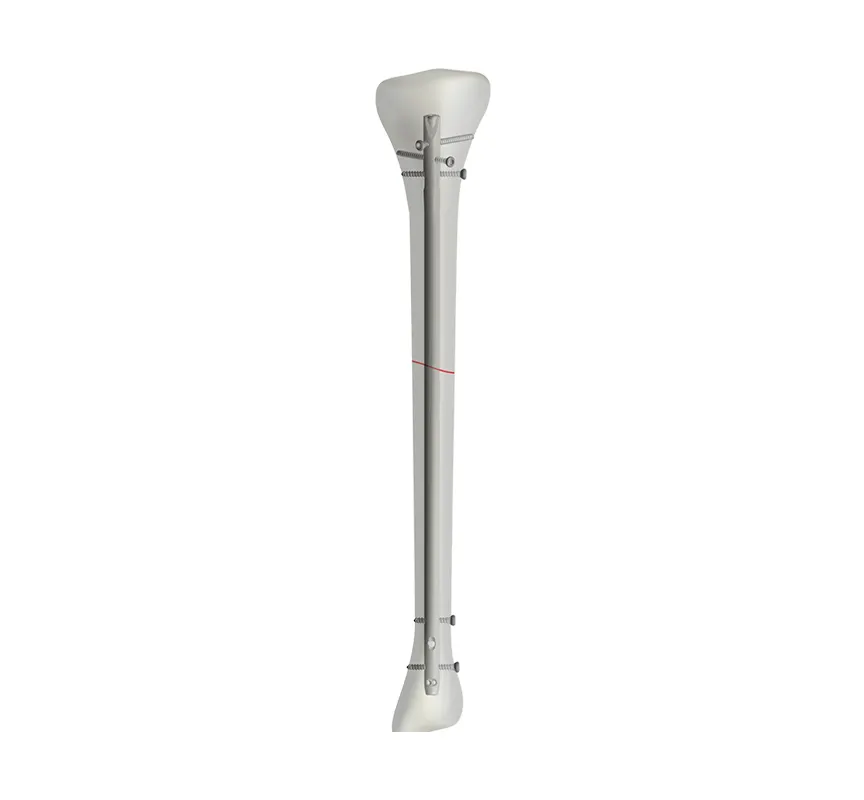
The Biomechanical Problem: Stress Shielding from Modulus Mismatch
Wolff's Law and Strain-Driven Bone Remodeling
According to Wolff's Law, bones change their structure based on the mechanical stresses they experience. The problem arises when we look at medial tibia plates made from materials like titanium, which has a modulus of elasticity around 110 GPa compared to just 10-30 GPa for actual bone tissue. This big difference creates what doctors call a biomechanical mismatch. What happens next is pretty concerning: the implant ends up taking over most of the workload during normal activities, leaving the surrounding bone without enough stimulation to stay strong and dense. Research into this area indicates that traditional high modulus plates can actually reduce tibial strain by about 40%, leading to muscle weakening over time and eventually causing the body to break down bone tissue progressively. This is why many orthopedic specialists are now looking for alternative solutions that better match the natural properties of human bone.
Clinical Consequences: Tibial Bone Loss and Implant Failure
Stress shielding drives two interrelated failure pathways:
- Peri-implant osteoporosis: Reduced mechanical stimulation lowers bone mineral density, increasing refracture risk by 25–60% near plate margins
- Secondary instability: Resorbed bone permits micromotion at the bone–implant interface, accelerating screw loosening in 18% of cases
In active patients, cyclic loading intensifies this cascade—often requiring revision surgery within 5–7 years. Precision modulus matching directly counteracts these mechanisms by restoring physiologic load transfer to the medial tibia.
Modulus of Elasticity Matching in Tibia Plate Design
Titanium vs Cortical Bone: Quantifying the Elastic Modulus Gap
Titanium alloy plates often used for fixing broken tibias have an elastic modulus around 110 to 120 GPa, which is about eight times what we see in human tibial cortical bone (which measures between 13 and 18 GPa according to the Material Properties Database from 2023). This big difference causes problems because these really stiff plates take over most of the weight bearing, basically letting the nearby bone go unused. Studies using computer models show that bones underneath regular plates experience about 70 to 80 percent less stress (as reported in Orthopedic Biomechanics Review last year), something that goes against Wolff's Law and leads to bones getting weaker over time. What happens then is pretty bad for bone health, making things especially tricky when doctors need to remove the hardware later on or if there's another injury down the road.
How Modulus Matching Optimizes Load Transfer to the Medial Tibia
When the stiffness of plates matches what we see in cortical bone around 15 GPa mark, that's when we get the best possible load transfer. Around this point, most studies show about 85 to 90 percent of those vertical forces actually go straight into the inner part of the tibia. This helps maintain how our bodies naturally handle weight and keeps those important strain patterns going through the bone that tell it to grow stronger. Looking at real world results from recent clinical trials, there seems to be roughly 40 percent less loss in bone density under these specially matched implants compared with regular titanium ones according to findings published last year in the Journal of Orthopaedic Research. Getting this balance right between the implant and surrounding bone tissue makes a big difference too. It cuts down on problems with screws moving around, minimizes tiny cracks forming around the implant site, and prevents excessive pressure building up in that weak spot on the inside of the tibia. All these factors work together to speed up healing and help patients get back to normal activities faster after surgery.
Next-Generation Solutions: Composite Plates for Precision Modulus Tuning
CFR-PEEK and Magnesium Alloys: Achieving Near-Native Bone Modulus
The combination of carbon fiber reinforced polyetheretherketone (CFR-PEEK) and certain magnesium alloys allows for tibia plates that match the bone's natural modulus of elasticity. These materials achieve stiffness levels around 18 to 20 GPa, which is pretty close to what we see in cortical bone tissue. Titanium implants have a much higher rigidity at about 110 GPa, and this difference can cause problems. When implants are too stiff compared to bone, they disrupt normal strain patterns in the medial tibia area. This leads to issues like stress shielding where the bone doesn't get properly loaded, eventually causing disuse atrophy. Studies indicate that CFR-PEEK plates cut down on implant failures by roughly 40% when compared to traditional metal options. They do this because they maintain those important mechanical signals needed for proper bone healing processes. Magnesium based alloys take things even further by integrating better with living tissues. They degrade at controlled rates and actually promote new bone growth through their osteoconductive properties. What we're seeing here represents something significant in orthopedic surgery. We're moving away from just providing structural support towards creating implants that work with the body's natural mechanics instead of against them.
FAQ
What is stress shielding?
Stress shielding occurs when an implant absorbs too much load, leading to insufficient mechanical stimulation of the surrounding bone tissue, eventually weakening the bone.
Why is modulus matching important in tibia plates?
Modulus matching aims to align the stiffness of the implant with the natural properties of bone, ensuring proper load distribution and promoting bone health and healing.
What are the benefits of using CFR-PEEK and magnesium alloys in tibia plates?
CFR-PEEK and magnesium alloys closely match the elasticity of bone, preventing stress shielding, improving load transfer, and promoting bone growth.
How does modulus mismatch lead to implant failure?
Modulus mismatch leads to stress shielding, which reduces bone density and stability, increasing the risk of refraction and screw loosening.